By
Michael Bird
•
20
min read

Trust has become one of the most valuable currencies in the apartment sector. Buyers are more informed, regulators are more active, and financiers are examining risk in greater detail. In this environment, the developers, builders and partners who can demonstrate quality and accountability are the ones who are winning buyer confidence.
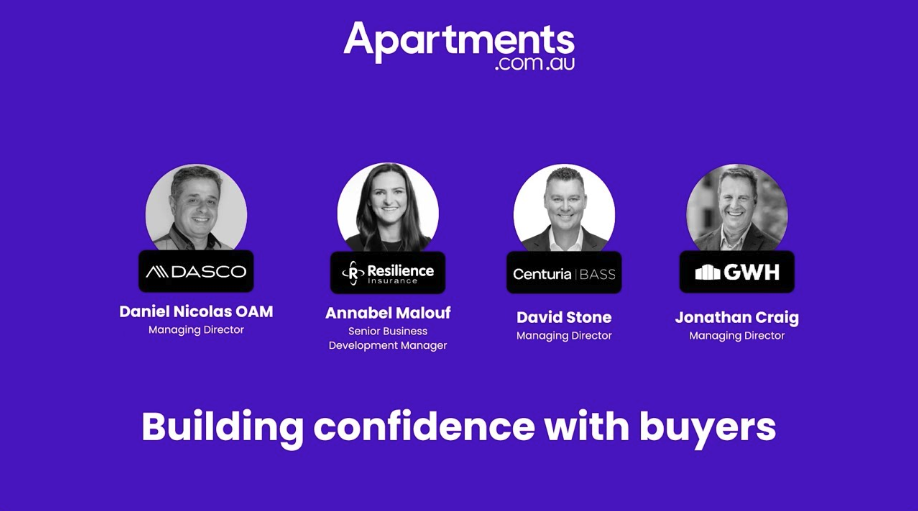
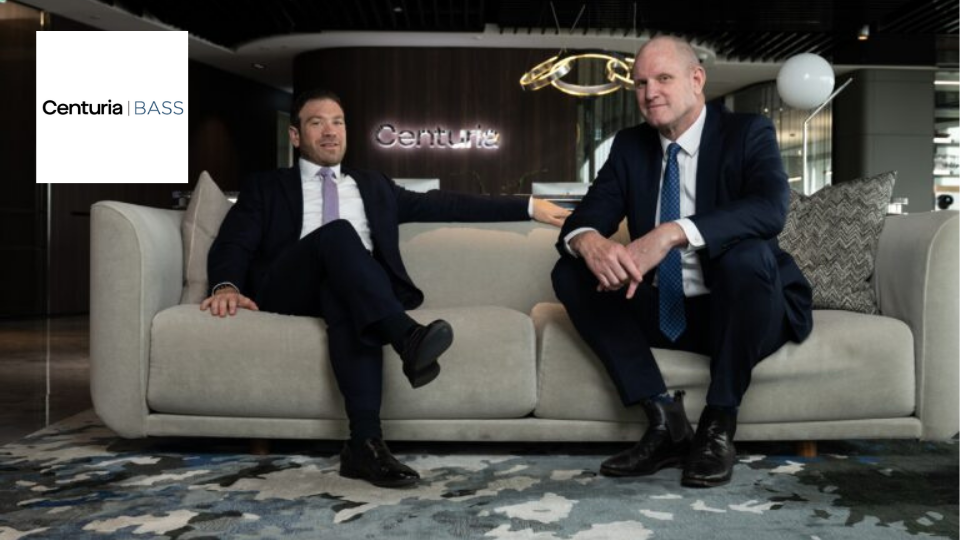
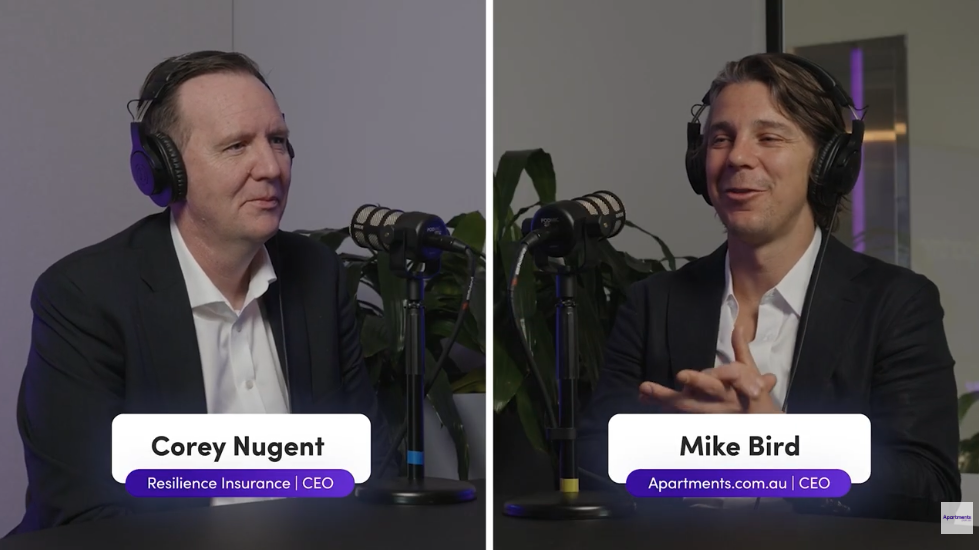
In this panel, hosted by Apartments.com.au, Daniel Nicolas OAM (DASCO Australia), Annabel Malouf (Resilience Insurance), David Stone (Centuria Bass) and Jonathan Craig (GWH) join Mike Bird to unpack what actually builds confidence with buyers today, and how regulation, insurance and finance are reshaping behaviour across the industry.
Both DASCO Australia and GWH operate as builder developers, and see that vertical integration as central to delivering quality and building trust with buyers and financiers.
Daniel Nicolas OAM explains that from day one, DASCO Australia has run two lines of business: building for clients and developing its own projects or joint ventures.
“With 32 years of trade, we have accumulated knowledge. Often we have skin in the game, but even when we build for third party developers, we understand the pain they can go through and the financial challenges they face, because we are developing in parallel.”
For Jonathan Craig, the builder developer model has evolved over time at GWH, but the logic is similar.
“We set up a construction arm in the mid 1990s. Having that background in construction makes the evolution into development easier. Most of our projects now are as builder developer, especially in multi storey residential.”
This alignment of interests is not only attractive to buyers. It also matters for capital.
David Stone from Centuria Bass notes that a decade ago, lenders often penalised builder developers.
“In the past, you might give them five per cent less leverage. Now we see the benefits. Vertical integration means feasibility is better understood and margins are clearer on both the development and construction side. Goals are aligned, and that makes us more comfortable.”
From an insurance perspective, the relationship between builder and developer has a direct impact on risk.
Annabel Malouf from Resilience Insurance explains that LDI is very sensitive to culture and communication inside the delivery team.
“When we are looking at insurance risk, it is central that the builder and developer work tightly together. Communication, focus on quality and accountability are key. When it becomes a transactional relationship, we tend to see quality diminish and defects increase.”

The panel agrees that the building commissioner has lifted standards, but there are nuances in how this plays out on projects.
From a finance lens, David sees clear positives.
“The commissioner has done a good job in ensuring the industry is performing. It gives consumers more confidence, especially buying off the plan. Buyers are more discerning now. Many wait to see a site started before committing to pre sales.”
On the delivery side, Jonathan and Daniel both acknowledge the benefits, while also pointing to the cost and process load.
Jonathan notes that for GWH, the commissioner did not change how they build, but did change how they document.
“It has come with a significant time and cost impost, which ultimately gets passed to the end user. We have a good relationship and the outcomes have been positive, but the process could be more seamless and more collaborative, especially for trusted operators.”
Daniel highlights that DASCO anticipated a commissioner style framework years ago and built systems accordingly.
“For us it was not strange dealing with the building commissioner because as third party builders we always had someone to answer to. The commissioner has flushed out bad operators and lifted everyone’s game, including consultants and subcontractors. It has been a win for the product, but there is definitely a cost.”
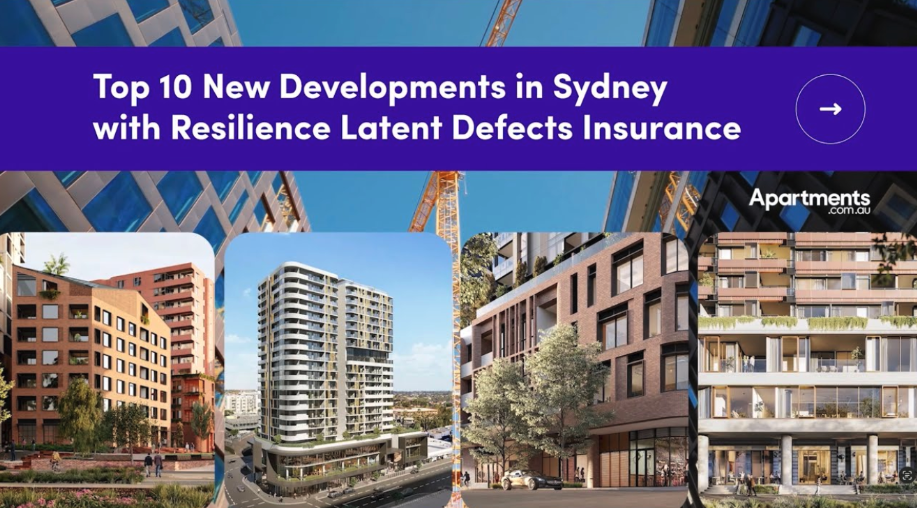
Latent defects insurance is emerging as a major pillar of buyer confidence, and as a genuine point of differentiation for better builders and developers.
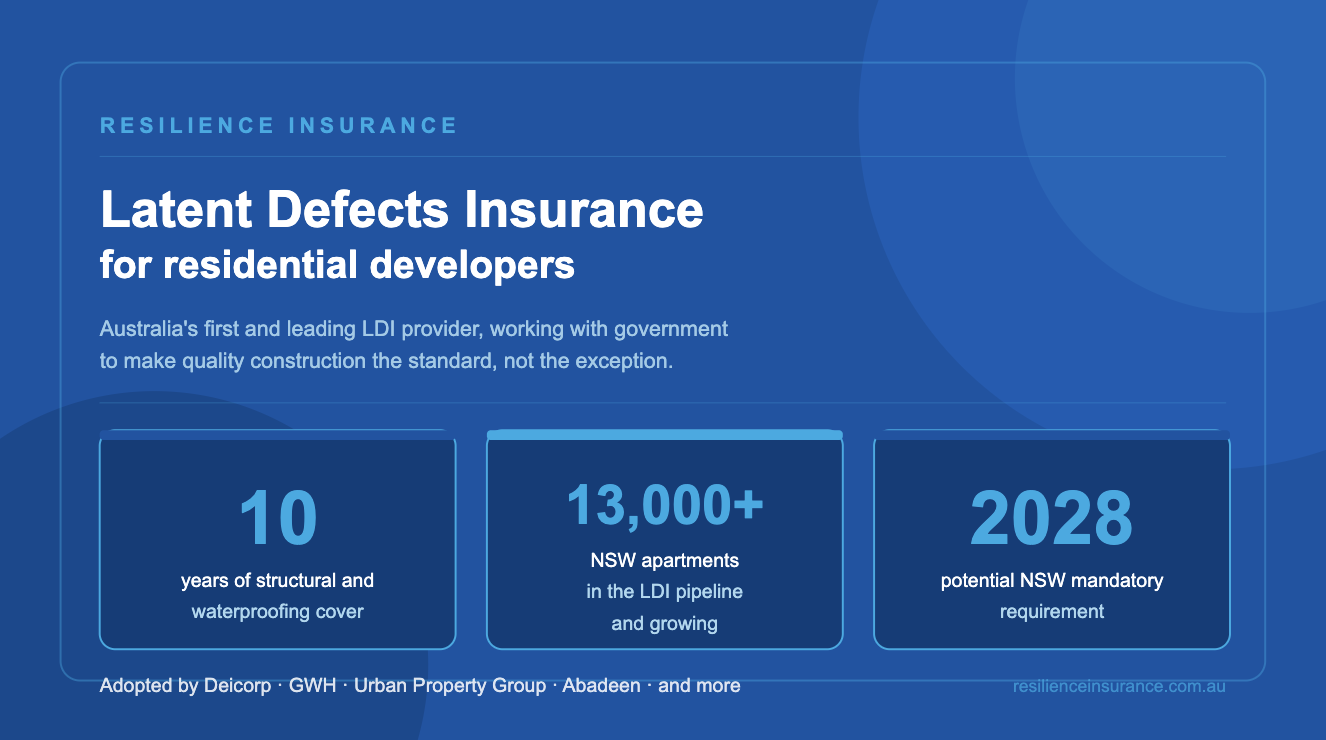
Resilience Insurance’s LDI product provides 10 year protection for structural and waterproofing defects, supported by a technical inspection service throughout construction.
Annabel sees the government bond and warranty schemes as a starting point, but believes LDI goes much further.
“The bond and warranty are good stepping stones, but we would like to see LDI uptake become mandatory. Unless you are inspecting while it is being built and making sure it is built properly, you are not addressing the core risk. That is where LDI stands out.”
Both DASCO and GWH are using LDI on their projects.
Daniel notes that DASCO was one of the earliest adopters and has seen the commercial upside.
“We were one of the first to take LDI. There was a spike in sales when it was announced. On all our developments we have now taken LDI. For us it is part of marketing. You are better off selling with an LDI premium than not selling at all. We treat it as an investment.”
Jonathan has recently moved from the old developer bond regime to LDI on new projects.
“We look at bonds as a sunk cost. Managing a bond across 100 or 200 strata owners is not a good experience for anyone. LDI and the clarity it provides is a better outcome for all. We welcome the technical inspections. It is great to have third party verification as we go.”
From a finance perspective, David confirms that LDI also improves lender confidence. Insurance quality is now a major component of construction risk assessment at Centuria Bass.
Platform data from Apartments.com.au shows a clear lift in willingness to pay when projects offer LDI protection, and the panel agrees that buyers value the assurance.
The group treats the cost of LDI less as a surcharge and more as a lever for conversion and pricing strength. If the product helps sell faster and more confidently, it quickly becomes an investment rather than an overhead.
The panel’s forward outlook varies by region.
Newcastle
Jonathan is optimistic about conditions for GWH. Cost bases have stabilised, long standing supplier relationships help keep delivery efficient, and most buyers are downsizers who are less constrained by affordability.
Sydney
Daniel highlights the affordability pressure for DASCO Australia. Anything above one million dollars is difficult to sell, while delivering new stock below one million is almost impossible in many Sydney locations. Startup rates remain low despite a large pipeline of approvals.
National view
From a national perspective, David sees construction cost escalation flattening, although pressures will vary by state. Brisbane, for example, may face labour shortages as Olympic related works accelerate.
For an industry built on confidence, the conclusion is clear. Groups that demonstrate proven delivery capability, transparent quality controls and long term protection for buyers are best placed to secure capital, drive sales and maintain momentum through the next cycle.
.jpeg)
Speak to the team about leveraging the Apartments.com.au audiences and services for your new development.

Greg Billings
Director of Residential Projects

Sonia Fava
Director

Nick Clydsdale
Senior Director

Heath Thompson
Director

Todd Matheson
Director

Thomas Panson
Project Sales & Marketing Agent

Scott Jessop
Head of Sales & Marketing

Alex Adams
Head of Sales & Marketing and
Head of New Business








.jpg)


.png)



-03.png)







.png)
.png)
.png)



_page-0001.jpg)
.png)






.png)



.png)


-01.png)


