By
Joel Robinson
•
2
min read


Australia's push to accelerate housing supply is running into an increasingly important question: does the construction industry have the capacity to deliver the pipeline being created?
New data from iCIRT and Equifax has highlighted growing pressure across Australia's builder and subcontractor market, with small construction business exits surging while new entrants decline and investment in equipment and growth contracts.
The inaugural iCIRT Construction Index: Capacity Report combines YouGov research with Equifax commercial credit and payment data to examine the operational and financial constraints sitting behind Australia's housing delivery challenge.
Its findings suggest the housing shortage cannot be addressed through planning reform and project approvals alone.
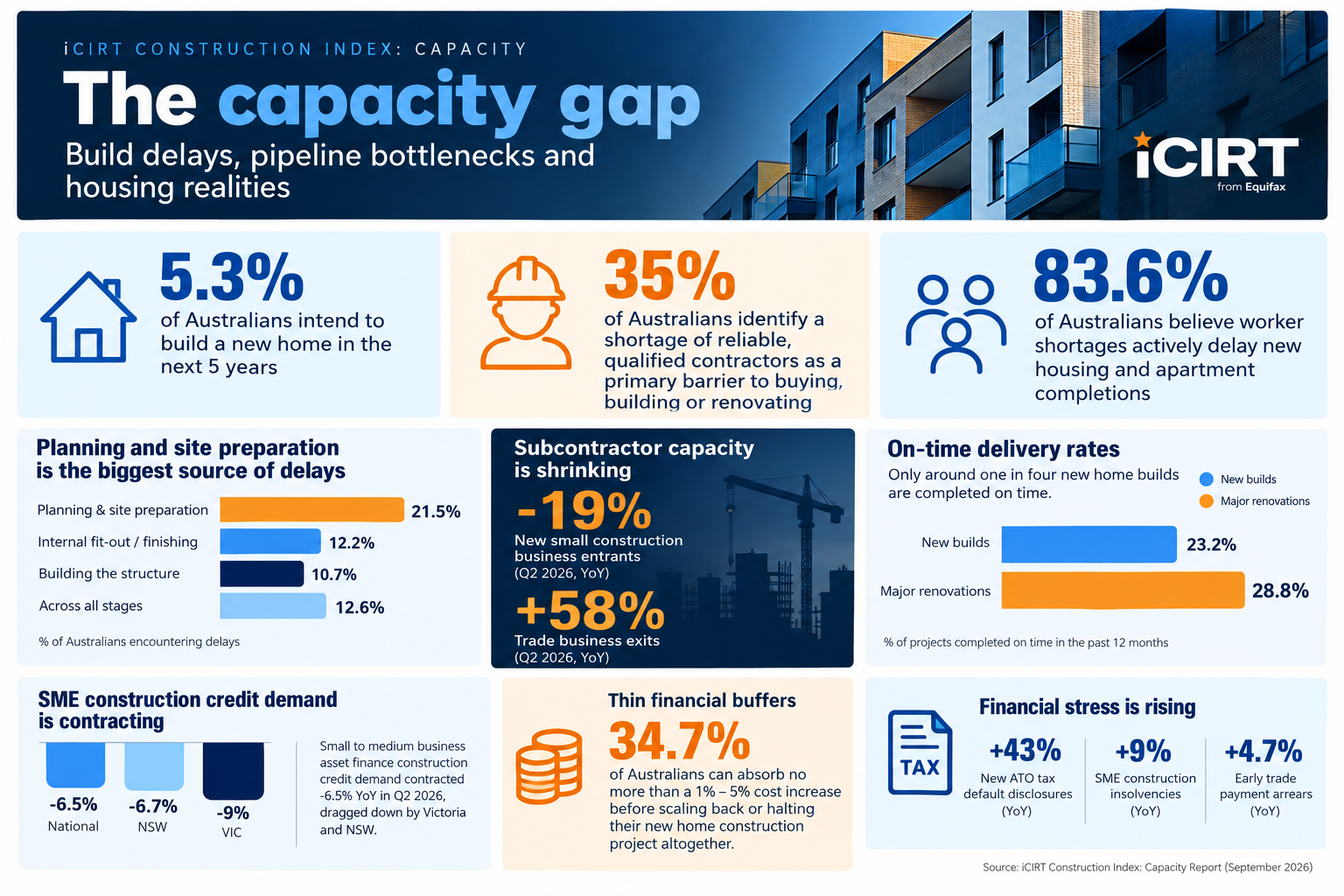
Small construction business exits increased 58 per cent year-on-year in the June quarter, while the number of new entrants fell 19 per cent.
Across the construction industry more broadly, entity exits increased 114 per cent year-on-year.
At the same time, SME construction credit demand contracted 3.8 per cent, including a 6.5 per cent fall in asset finance as smaller businesses deferred investment in equipment.
The contraction was particularly pronounced in Victoria and NSW, where SME credit demand fell nine per cent and 6.7 per cent respectively. Queensland was comparatively resilient, with demand remaining flat, supported by major regional infrastructure and pre-Olympic civil commitments.
The numbers provide another dimension to Australia's housing supply debate.
Governments have spent the past several years attempting to unlock greater housing capacity through planning reform, accelerated assessment pathways and higher-density development around existing infrastructure.
The iCIRT data suggests getting projects approved represents only one part of the delivery equation.
Once projects move from planning into construction, the depth and financial strength of Australia's builder, subcontractor and trade network becomes increasingly important.
That network is facing its own pressures.
New ATO tax default disclosures among construction businesses increased 43 per cent year-on-year, while SME construction insolvencies rose nine per cent.
Early trade payment arrears also increased 4.7 per cent, while the report found smaller businesses were pulling back from capital investment.
Labour represents another major constraint.
Some 83.6 per cent of Australians surveyed believe worker shortages have an impact on the timely delivery of new housing and apartments, while 31.3 per cent consider trade shortages a critical threat to housing supply.
More than a third, 35 per cent, identified the availability of reliable and qualified contractors as a barrier to buying, building or renovating.
Planning itself remains another significant bottleneck.
The report found 21.5 per cent of respondents identified planning and site preparation, including council approvals, excavation and civil works, as the largest source of construction delays.
That compared with 12.2 per cent identifying internal fit-out and finishing and 10.7 per cent identifying construction of the building structure.
Equifax Australia General Manager Commercial Brad Walters said the constraints facing the sector had implications beyond individual projects.
"Construction underpins a good portion of Australia's broader economic activity and workforce, but our research shows the sector is facing constraints on the ground," Walters said.
He said addressing Australia's housing ambitions required greater attention to the capacity bottlenecks and financial pressures facing builders and trades.
The findings also put greater emphasis on the financial strength and capability of the businesses that remain active in the development and construction sector.
While SME construction credit demand contracted, larger construction businesses recorded three per cent year-on-year growth in credit demand, suggesting a divergence between larger operators and the smaller businesses that form a significant part of the construction supply chain.
That distinction is particularly relevant as Australia's apartment development pipeline increasingly shifts toward larger, more complex projects requiring significant balance sheets, established subcontractor networks and longer delivery programs.
For iCIRT, the capacity issue also strengthens the case for greater transparency around the businesses responsible for delivering new housing.
The rating system assesses construction businesses across their track record, financial backing, credentials, capability and integrity, giving buyers and industry participants an independent measure of the businesses behind new development.
The report ultimately points to a housing supply challenge extending well beyond the number of projects sitting within Australia's planning pipeline.
Approving the next generation of housing is one challenge. Ensuring the industry has the capacity to build it is another.

Speak to the team about leveraging the Apartments.com.au audiences and services for your new development.

Greg Billings
Director of Residential Projects

Sonia Fava
Director

Nick Clydsdale
Senior Director

Heath Thompson
Director

Todd Matheson
Director

Thomas Panson
Project Sales & Marketing Agent

Scott Jessop
Head of Sales & Marketing

Alex Adams
Head of Sales & Marketing and
Head of New Business




.jpeg)







.jpg)







.png)





-03.png)











.png)

.png)

.png)









_page-0001.jpg)

.png)














.png)




.png)


-01.png)


