By
Joel Robinson
•
9
min read


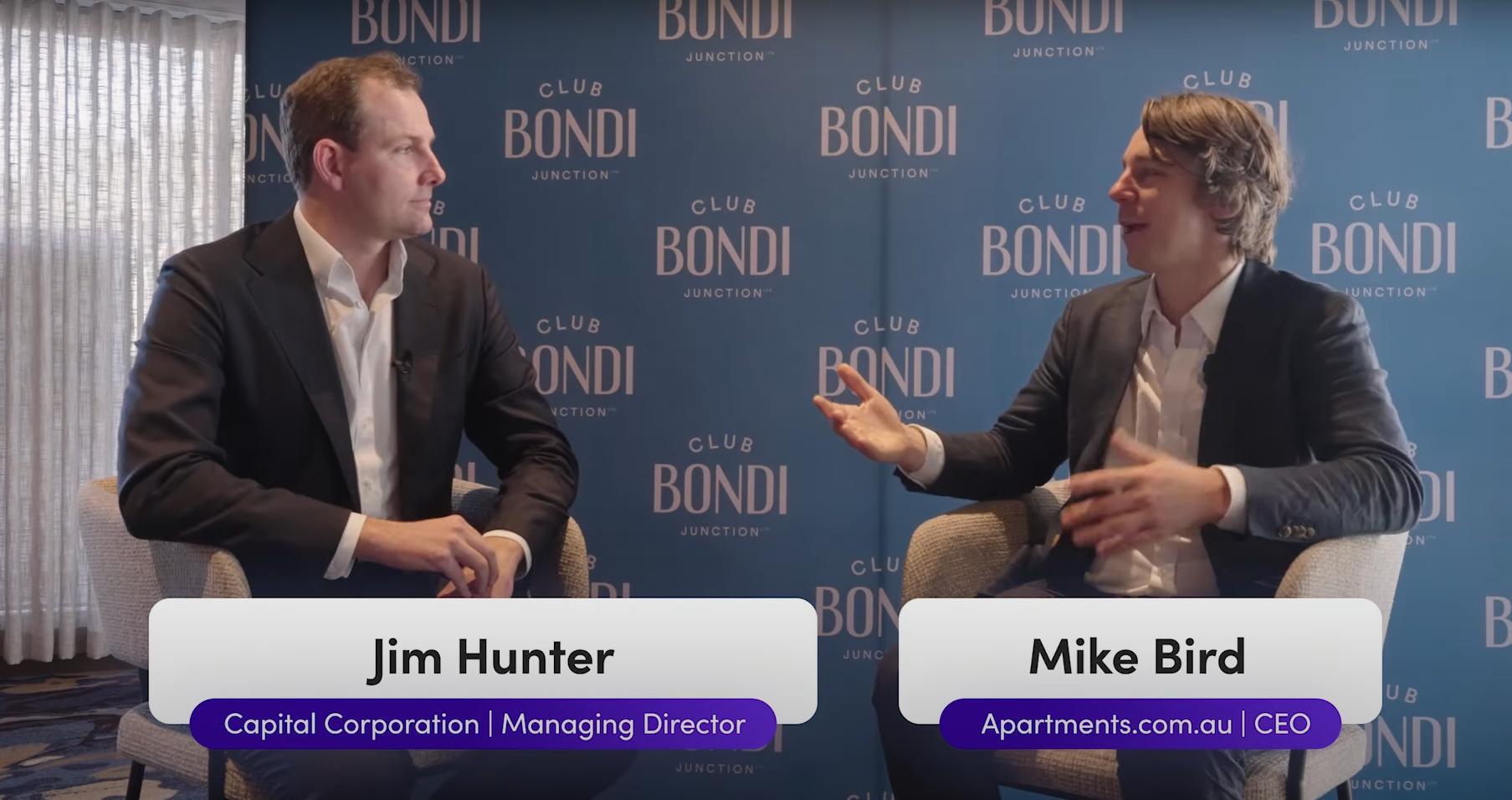
If Melbourne's apartment market feels quiet, look closer. At the Apartments.com.au Market Insights Live Event in Melbourne, three of the city's busiest sales and marketing operators joined host Mike Bird to talk through what is actually working in the off-the-plan market right now.
Fergus Humphries, Sales and Marketing Director at Hamton Property Group, Joelene Riedo, National Marketing & Customer Experience Associate Director at Colliers, and Vanessa Lai, Head of Media at Metropolis, covered everything from recent sales wins and channel strategy to construction costs, pricing and how buyer journeys are changing.
Fergus Humphries leads sales and marketing at Hampton Property Group, which is behind Moonee Valley Park, the redevelopment of the Moonee Valley racecourse. The $3.5 billion project is a joint venture with HostPlus, in partnership with the Moonee Valley Racing Club, and will deliver about 3,000 apartments in total. Hampton is about eight years and 600 apartments into the project. The group is also behind Scotch Hill Gardens in Hawthorn, a $600 million, 418-apartment project that has just started construction on its first stage.
Joelene Riedo heads up national marketing and customer experience at Colliers, overseeing the eastern seaboard, with the business also present in Perth and Adelaide. Based in the Victorian team, she is currently selling a significant volume of inner-city apartments, with Colliers also active in house and land in the outer ring and in the middle-ring metro market.
Vanessa Lai is Head of Media in Melbourne at Metropolis, an integrated property agency delivering media, performance, creative and social, which turned 20 this year.
Asked for a clickbait headline on the Melbourne off-the-plan market, Vanessa offered "Melbourne, less potholes, more cranes, please". The other two headlines from the panel: "Melbourne, not all apartments are equal" and "Everyone said don't buy off the plan. They may have got it completely wrong."
Fergus Humphries described current conditions as some of the most challenging he has seen in his 30-year career, but pointed to clear wins across Hampton's projects.
Hampton settled 364 apartments at Moonee Valley Park in November and December. Five or six of those contracts fell over, and all were resold within two months at higher price points. In the last three months, Hampton has also sold five penthouses priced between $4 million and $5.5 million across Moonee Valley Park and Scotch Hill Gardens.
Asked what was driving those results, he put it down to persistence and knowing the buyer:
"I think it's just perseverance, and knowing your buyers, and just doing what you do best and keeping on going. Everyone's generating leads. It's probably a bit quieter in terms of transactional volumes at the moment, but those leads turn into buyers, and they will buy at some point in the market cycle."
He added that he doesn't want to hear anyone say it can't get much harder, having heard that for the last 18 months.
Joelene Riedo, who started her career in Queensland, said the industry may be "believing our own hype" when it comes to bad news, and that Melbourne's fundamentals remain strong.
"From a Melbourne point of view, we've actually got a really strong fundamental. We've got excellent population growth, we've got excellent affordability compared to the other cities. We've got an extremely strong case around rentals. There's a lot to like. I just know the transactions aren't happening as fast or as much as we would like them to, but I don't think it's all doom and gloom."
She said Melbourne is well calibrated for any uplift, pointing to Queensland reaching a price cap on construction and Sydney facing more completed stock coming to market than it has had to deal with before.
Mike Bird added that much of Sydney's stock is fairly homogenous, concentrated in one or two precincts, which is contributing to completed stock sitting on the market because buyers have so much similar product to choose from. By contrast, he said Melbourne's stock is spread across areas as different as Brunswick and Richmond, rather than concentrated in a single pocket as parts of Southbank were five to 15 years ago.
Joelene agreed, saying that diversity means "everyone can find their own piece of Melbourne", and helps projects achieve the differentiation they need in market.
From Metropolis's vantage point across a wide portfolio of projects, Vanessa Lai said the clearest dividing line is brand investment.
"The campaigns that are successful are the ones that are actually investing in their brand and awareness. When we look at campaigns that don't, where they just rely on doing a listing and some performance social, we're not getting the same results as those developers that are spending that money up front."
She also said off-the-plan marketing has become much more personal over the last 12 months. Project sales agents are now doing what established agents have done for years, putting themselves into the marketing through video content, walkthroughs, floor plan explainers and project updates to build trust with buyers.
Vanessa pointed to Aberdeen's Grand View in Prahran as an example. Launched in early 2025 as the market was entering its downturn, the 26-apartment project was backed by a strategy that included all the core channels, plus outdoor, sponsored content and other media channels developers don't typically use. Metropolis worked closely with Marshall White to track where buyers were coming from and refine the media accordingly. Six apartments now remain.
She said the Grand View budget was one that some developers with double the number of apartments would halve, only to end up spending the same amount over four years.
On how brand and project marketing fit together, Vanessa said the focus is on multiple touch points and uncluttered environments. With every project on the property portals and social becoming very competitive, she said it's about finding channels where buyers are consuming content but that aren't crowded with competitors.
Asked where Colliers is seeing the greatest depth of demand, Joelene Riedo said it starts at acquisition: buying a site well with the end user in mind.
Colliers has two investor products in market, one in Southbank and one in the CBD, which launched on the day of the event. Both were set up for investors from the outset and are seeing strong investor demand. Its owner-occupier stock, particularly product aimed at downsizers and rightsizers, is also attracting strong enquiry, having been designed for that market from the start.
"It's not necessarily about there being extreme depth within market, but being very targeted and delivering with intention from the get-go. That's worked."
Both Joelene and Fergus described sales channels as core to their businesses rather than an afterthought.
At Colliers, channels are brought on at a project's inception and treated as a key customer.
"I have worked developer side, and I know that we can often say, 'We'll chuck it to the channels.' And we know that doesn't actually have the same impact. But if the sales objective and the strategy is we need velocity, we need to get pre-sales and we need them fast, then channels fill that."
She said listening to channel feedback is just as important, because developers ultimately need to win channels over for them to vouch for a project with their own clients.
Fergus called channels an extension of Hampton's business, used from the front end to reach financial close right through to clearing final stock.
"We know who's best suited to all different phases and stages of that cycle. So, without channels, we wouldn't have a business."
He said the mix has shifted over the past five years. When Moonee Valley Park started, sales were roughly 80 per cent retail and 10 per cent channels; that has since moved to around 60 per cent retail and 40 per cent channels.
On construction costs, Fergus said absorbing the gap between established and new pricing will take a significant period of time, with residual stock from recently completed developments also still needing to be absorbed. He put the price difference between comparable existing and off-the-plan stock at anywhere between 10 and 30 per cent, a range he conceded was generous.
"It's competitive. So you've actually got to have a unique selling proposition that defines who you are. I say to the development team the whole time: if the plan you've got, the price you've got and the position in the building's not right, you're not going to sell it."
Asked whether developers should cut finishes to lower costs or keep high-end finishes and lift prices, Fergus said there is a third answer: staying nimble. At Hampton, the scheme a project starts with isn't necessarily the one it finishes with, and the team focuses on getting unit mixes, sizes, price points and positioning right from the start.
He said there has been a push towards more owner-occupier three-bedroom product, but with house prices coming off and downsizers and owner-occupiers under pressure, Hampton is now actively cutting up some of those three-bedroom apartments. He also noted that one and two-bedroom apartments don't make developers money.
Customisation has also become standard. Hampton's customisation lists are extensive and sometimes meet resistance from builders, and it is doing more customisation now than ever before. While it isn't actively offered to market, he said 100 per cent of apartments are customised in some form, and buyers know it's a service Hampton provides.
Joelene Riedo said investors are more accepting of the cost of buying new, with a better understanding of the current cost environment and a less emotional decision to make.
"As soon as we're talking about that owner-occupier market, it's confidence: confidence in your own position and confidence in the value, and that's actually the fundamental for any of the other transactions that are going to take place. With an investor, it's a little bit more arm's length. You know the sums. You're not affecting your principal place, plus you've also got the tax benefits as well."
She added that with the price gap between established and new stock, it is harder to make the numbers stack up, and that understanding the consumer perspective is key to identifying roadblocks.
The panel also outlined how far pricing has moved. Three to four years ago, one-bedroom apartments with a car space were selling for about $450,000; they now sit between $680,000 and $750,000-plus. Two-bedroom apartments that sold for between $760,000 and $920,000 now sit between $1.2 million and $1.5 million. There is acceptance at those levels in parts of the market, such as singles and downsizers, but not across most of it, and three-bedroom product is meeting price resistance above $3 million to $3.5 million.
On whether stamp duty concessions are moving the needle, Vanessa Lai said they work best when the actual dollar saving is front and centre.
"It's definitely a hook, and the way you should communicate it is the actual amount of the savings. So not just 'stamp duty savings'. Have it in big, bold, whether it's $300,000 or $400,000. That's what's going to hook people in. But at the end of the day, it is about the product. If it's not suited to the buyer, then the financial incentive isn't going to work."
She said media strategy needs both an overarching brand and tailored messaging for each demographic within a project, from first home buyers and upgraders to downsizers and investors. Families may prioritise proximity to schools, while downsizers may respond more to messaging around security.
Fergus said Hampton runs between five and seven landing pages per project, segmenting data on that basis.
Fergus said Hampton has never relied on a single market segment, and that diversity of product is what protects a developer in conditions like these.
"You will always be able to find one segment of the market to activate at any point in time. If you're heavily invested in owner-occupied downsizers, and that's where the majority of your stock is in these times, that's going to be hard."
He said investors are currently buying one and two-bedroom apartments without issue, and warned developers at scale not to load up too heavily on three and four-bedroom product expecting it to carry a project long term.
Joelene said broad buyer categories can be misleading. Of the buyers for Colliers' investor-led CBD product, 78 per cent are white-collar workers earning around $75,000, with an average age of around 30, challenging the perception that the market is largely students.
She also said "downsizer" is a broad term, and not everyone in that group is buying in the $3 million to $4 million band.
"One of the key things that we talk to our clients about is affordability is subjective, but attainability should actually be top of mind."
She said many downsizers have spent 20, 30 or 40 years in an area, with social connections, their doctor and family nearby, so the opportunity is in giving them attainable product in the locations they want. With most downsizers living alone or in households averaging about 1.4 people, she said the focus should be on product that suits a small household while still offering a big lifestyle.
Asked what the biggest change in the Melbourne apartment market will be by September 2027, Vanessa Lai returned to brand. With the buyer journey taking much longer, she said marketing has to work harder, requiring more content, more stories and more creative messaging.
She also said Metropolis recently built an API with one of the bigger CRM companies, plugging it directly into its media reporting dashboard. That allows the agency to optimise campaigns towards appointments and analyse the behaviours leads take before they enquire, rather than focusing on the lead itself.
Joelene Riedo described Melbourne as "Australia's best kept secret" and said the city is best positioned for the next recalibration, with Colliers seeing strong enquiry and purchases from Sydney and Brisbane buyers drawn by Melbourne's pricing and rental returns. Mike Bird added that Melbourne is the most popular state for the investor cohort on the Apartments.com.au platform, "and it's not even close".
Fergus Humphries said build prices aren't likely to fall any time soon, and pointed to strong enquiry from Sydney, Western Australia and Queensland. He said it would only take one change, such as a shift in government taxation settings, to see an uptick.
"I feel like all the bad levers are pushed over to one side. So it'll just take any one of those things to change, and then we'll see an uptick. After every drop, there's always an increase."
The full Sales & Marketing panel from the Melbourne Market Insights Live Event is available to watch above.
For the full event summary, presentation download and photo gallery, visit: VIC Market Insights Event Summary September 2026
Join the waitlist for upcoming Market Insights Live Events: Market Insight LIVE Events Join the Wait List
In partnership with Resilience Insurance, iCIRT from Equifax, Artis, Urbis, Queers in Property and Conversion Assist.

Speak to the team about leveraging the Apartments.com.au audiences and services for your new development.

Greg Billings
Director of Residential Projects

Sonia Fava
Director

Nick Clydsdale
Senior Director

Heath Thompson
Director

Todd Matheson
Director

Thomas Panson
Project Sales & Marketing Agent

Scott Jessop
Head of Sales & Marketing

Alex Adams
Head of Sales & Marketing and
Head of New Business







.jpeg)







.jpg)






.png)





-03.png)









.png)

.png)

.png)








_page-0001.jpg)

.png)










.png)




.png)


-01.png)


