By
Joel Robinson
•
3
min read

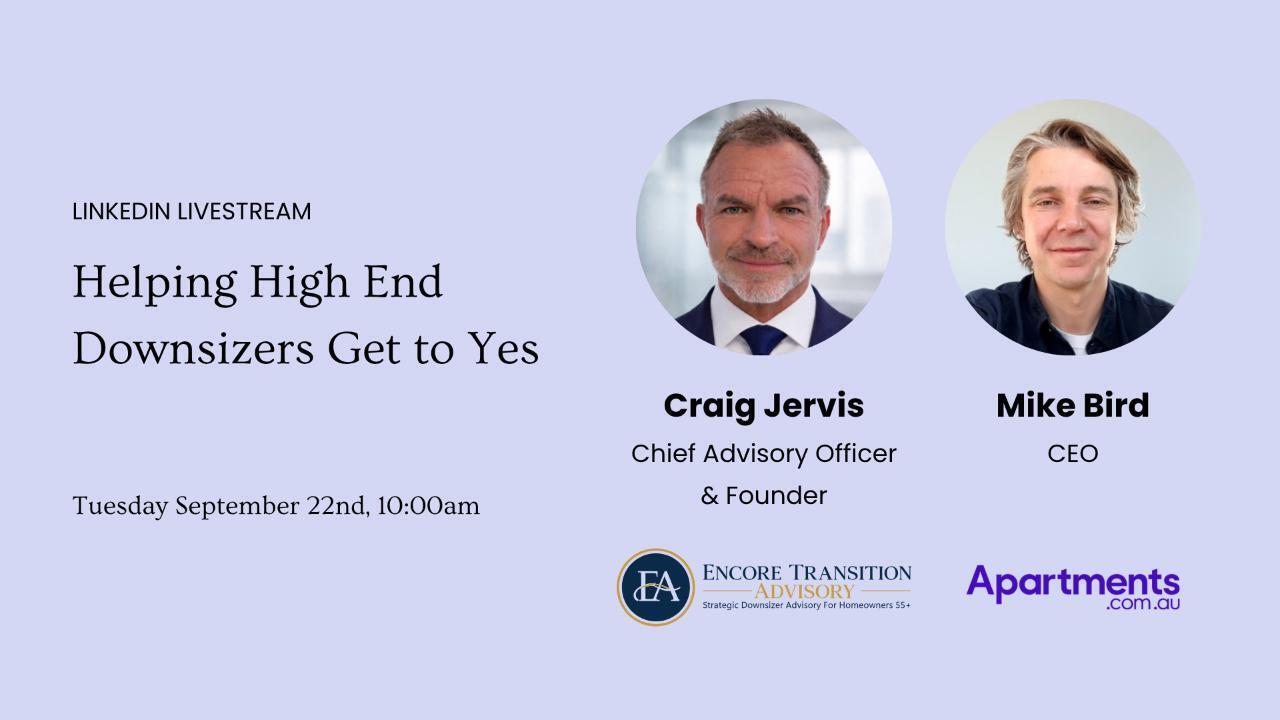
Australia's affluent downsizers are becoming the driving force behind the new apartment market, but financial capacity doesn't always translate into a signed contract. For developers and project marketers, understanding what happens between a buyer falling in love with an apartment and actually committing to it has never been more important.
In the latest Apartments.com.au podcast, Mike Bird speaks with Craig Jervis, Chief Advisory Officer and Founder of Encore Transition Advisory, about the financial, emotional and family dynamics shaping downsizer decisions, and why the traditional sales approach may be missing the real barriers to purchase.
More than half of Apartments.com.au's audience is now aged over 55, reflecting a significant shift in demand towards apartments designed for downsizers.
Jervis believes the influence of this demographic extends well beyond enquiry numbers.
"The over-55s, they control over 50% of private wealth in Australia," he explains, noting that the cohort represents approximately 28 to 29 per cent of the population.
For developers, that concentration of wealth has implications for everything from apartment design and pricing to project feasibility and sales strategies.
"Understanding downsizing or rightsizers, this buyer profile, it's not a niche anymore. It's a commercial and strategic necessity."
One of the biggest misconceptions about affluent downsizers is that their financial position makes purchasing straightforward.
Many have owned their family homes for 20, 30 or even 40 years, accumulating substantial equity while building a lifetime of memories.
Moving means more than changing addresses. It can involve restructuring capital, reconsidering retirement plans, navigating estate planning and confronting the emotional significance of leaving a long-held family home.
"The family home is a trophy for some people. It's their identity," Jervis says.
Wealth can also introduce more complexity, with accountants, financial planners, private bankers, estate planners and family members approaching the same decision from different perspectives.
Jervis points out that only around 16 per cent of Australians receive financial advice, highlighting the disconnect between financial wealth and confidence in making major financial decisions.
For project marketers dealing with qualified buyers who hesitate to commit, the instinct can be to introduce incentives.
Stamp duty contributions, furniture packages or price reductions may help some purchasers, but Jervis warns they can be counterproductive when affordability isn't the issue.
"If their barrier is not financial and the price and they're okay with the price in the apartment, all you're doing is giving away margin."
Instead, he recommends identifying whether price is genuinely the obstacle before offering concessions.
A more productive question might be: "What else needs to be right for you to be able to move forward?"
That simple shift creates an opportunity for buyers to discuss concerns around selling their existing property, family expectations, retirement finances or the timing of their move.
One of Jervis's more practical observations concerns the people influencing a purchase beyond the primary decision-maker.
"I always also look for, I say to salespeople, look for a disengaged partner as well."
Couples can attend appointments together while holding very different expectations about downsizing. Those differences may only emerge after several meetings.
Adult children can introduce another layer of complexity, particularly when concerns arise around off-the-plan purchases, financial security or inheritance.
Jervis explains that bringing influential family members into an independent advisory conversation can help address those concerns before they derail an otherwise suitable purchase.
The objective is not to pressure everyone towards agreement, but to establish clarity around a decision with lasting consequences.
Through Encore Transition Advisory, Jervis works with both individual downsizers and development sales teams, providing independent guidance on the broader transition rather than selling property.
He argues that this advisory pathway should be considered from the beginning of a project's sales strategy, rather than introduced only when buyers become difficult to convert.
Educational events are another opportunity. Rather than focusing exclusively on apartments, Jervis recommends helping prospective purchasers understand the process of selling their homes, managing capital and preparing for their next stage of life.
Bird also highlights the importance of marketing beyond the initial enquiry, including digital search, emerging AI discovery channels and premium printed material that buyers can take home to discuss with partners or family.
The conversation also explores the emerging relationship between luxury apartment living and in-home care, with some older purchasers seeking homes that can accommodate additional support without entering traditional aged care.
For Jervis, this reflects a broader structural shift in how apartments will be designed, marketed and sold.
Deposit bonds may also provide a practical solution for some asset-rich but cash-constrained purchasers, helping them manage the timing of capital commitments, subject to their circumstances.
Ultimately, the message for developers and project marketers is that securing a downsizer purchase requires more than presenting the right apartment at the right price.
It requires understanding the decision surrounding it.
As Bird concludes, sales teams need a "safe avenue" for buyers who cannot move forward through the traditional sales process.
For Australia's increasingly influential downsizer market, the difference between hesitation and commitment may come down to feeling understood, informed and confident enough to take the next step.

Speak to the team about leveraging the Apartments.com.au audiences and services for your new development.

Greg Billings
Director of Residential Projects

Sonia Fava
Director

Nick Clydsdale
Senior Director

Heath Thompson
Director

Todd Matheson
Director

Thomas Panson
Project Sales & Marketing Agent

Scott Jessop
Head of Sales & Marketing

Alex Adams
Head of Sales & Marketing and
Head of New Business







.jpeg)







.jpg)






.png)





-03.png)











.png)

.png)

.png)









_page-0001.jpg)

.png)











.png)



.png)


-01.png)


